Overview
Craft in Motion is an interactive experience about the contrast between performance and exhaustion behind the bar.
Bartending can look effortless from the outside: precise movements, fast service, conversation and a constant smile. Behind that performance is repetition, physical fatigue and the pressure to stay composed while everything around you moves faster.
The experience uses body tracking, motion, sound and animation to make that invisible effort tangible.
Personal context
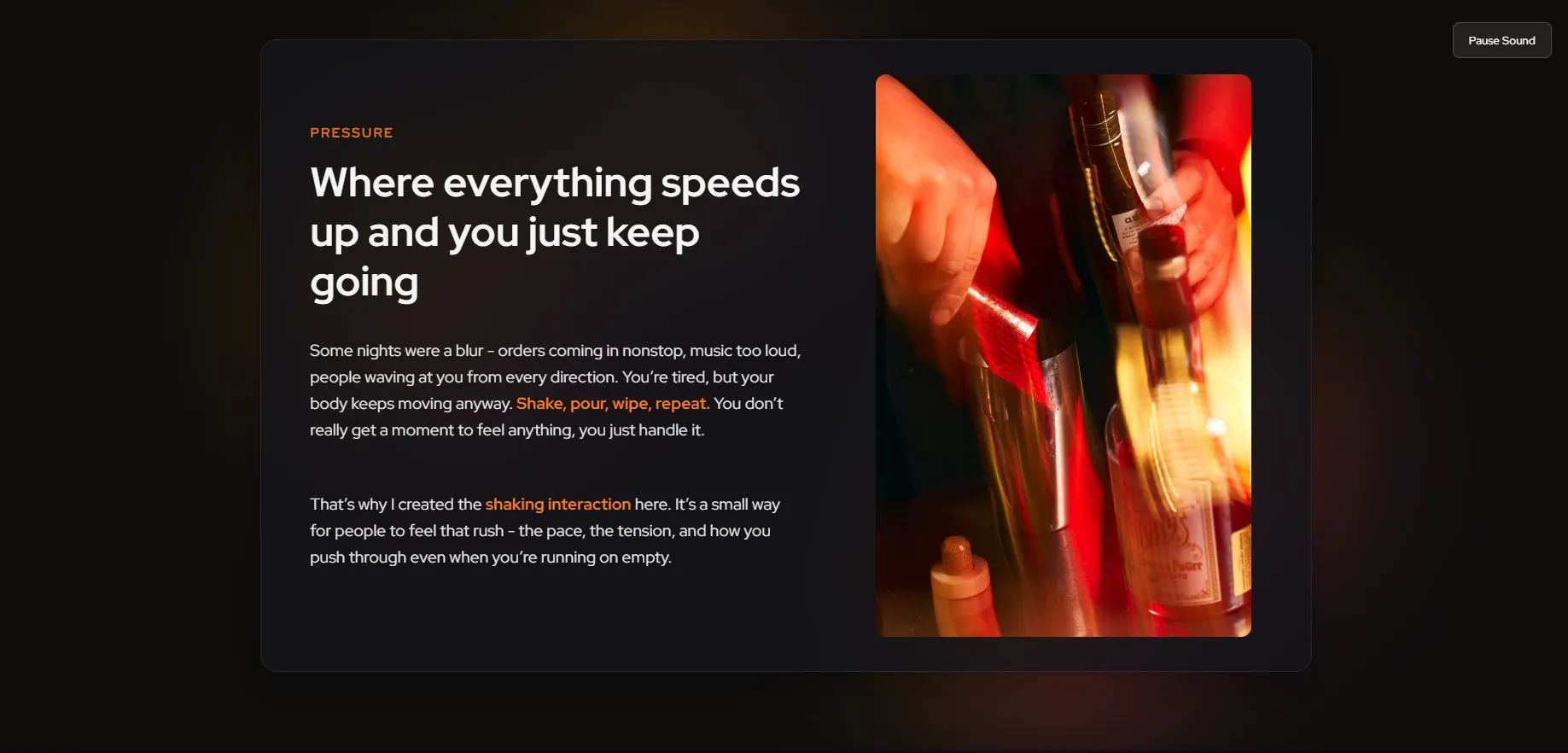
I worked as a bartender for four years.
It was creative and social, but also physically and emotionally demanding. Even when exhausted, you keep moving, stay precise and continue performing for the people in front of you.
Craft in Motion grew from that experience.
Rather than recreating bartending literally, I wanted to capture its rhythm: staying in control while pressure, fatigue and repetition gradually build around you.
Motion tracking
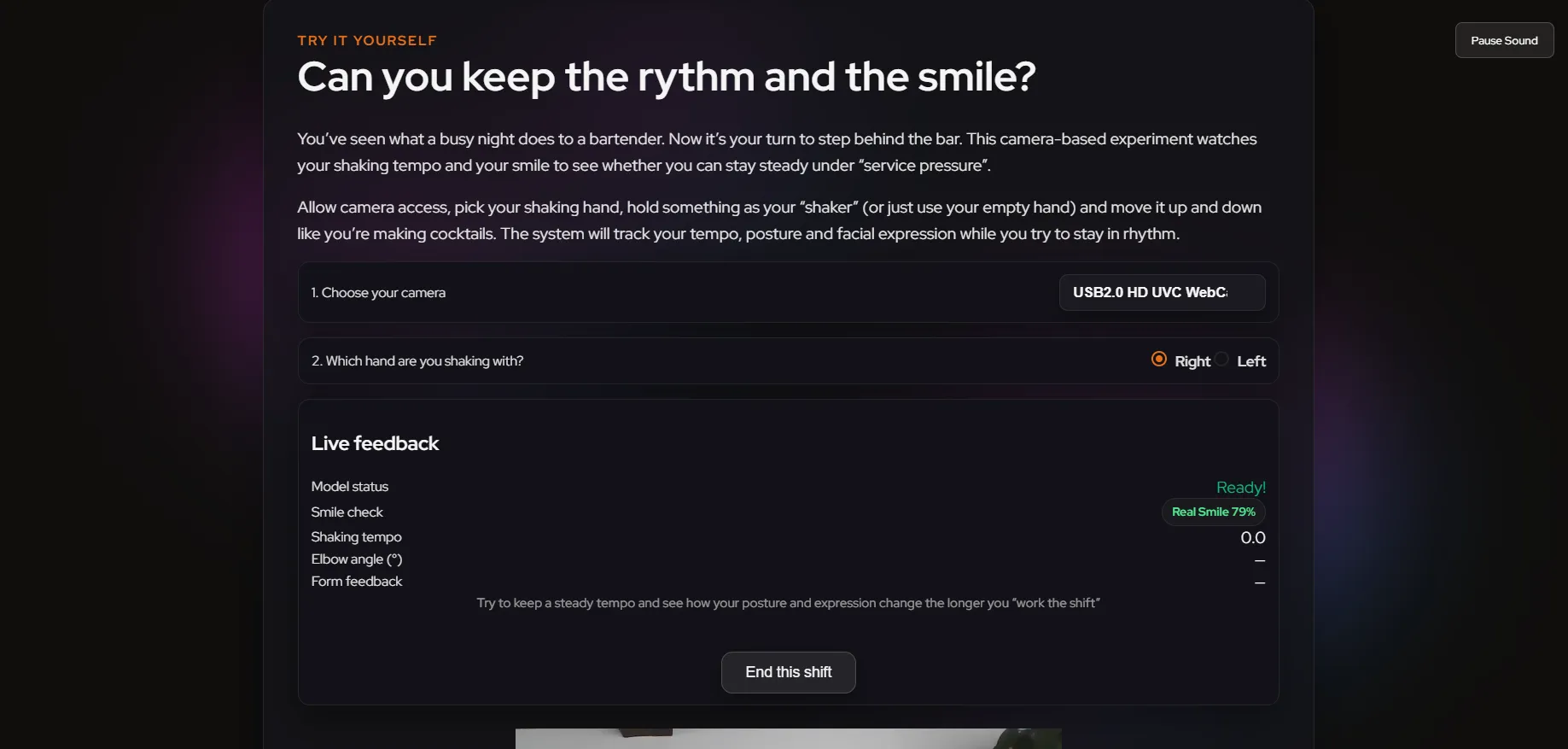
The interaction uses PoseNet through ml5.js to track upper-body movement while the user performs a bartending motion with a physical cocktail shaker.
The system looks at signals such as:
- arm and elbow position
- shaking tempo
- movement consistency
- changes in rhythm over time
Those measurements feed a live feedback panel — shaking tempo, elbow angle as a proxy for “form”, and a smile reading from my custom ML model — rather than being presented as raw data.
Performance under pressure
A second layer uses a custom machine-learning tool I built: a smile model that calibrates eye-region dynamics across frames and estimates whether the expression reads more artificial or genuine.
That reading drives a performance or “mask” meter.
The intention is not to determine what the user truly feels, but to explore the contrast between physical effort and the composed expression expected during service.
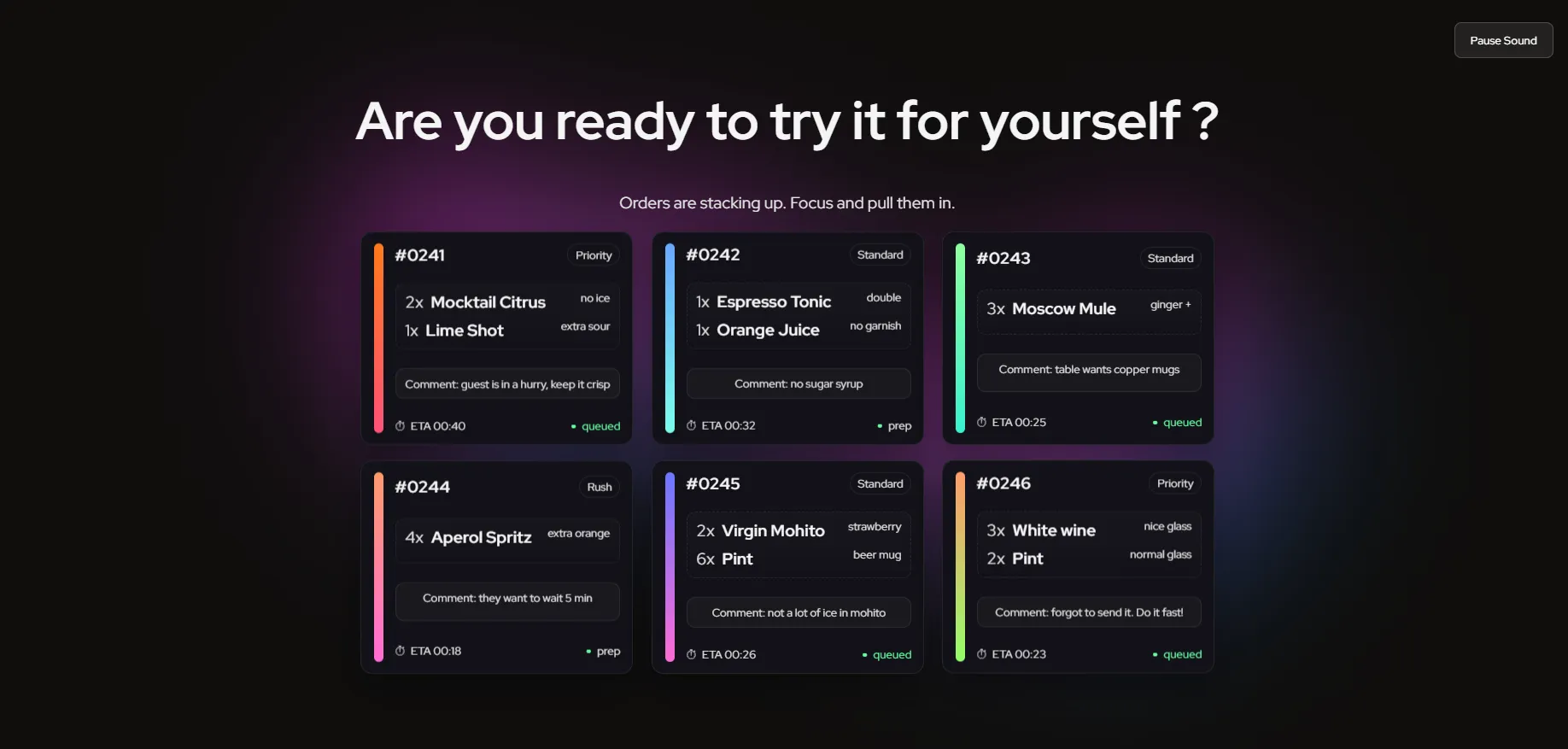
Around the interaction, a service-pressure layer stacks up the night: orders arrive with deadlines and ETAs that start to slip the moment your rhythm breaks.
Recorded bar ambience, glasses, orders, ticket-machine sounds and short calls such as “Faster!” recreate the feeling of a busy service environment.
Motion and storytelling
I used GSAP to connect the interactive experiment with the surrounding narrative.
ScrollTrigger controls the opening story, while Flip and MotionPathPlugin create transitions and movement throughout the experience.
The visual system reacts alongside the body tracking, turning changes in movement and rhythm into part of the interface.
Physical + digital
A cocktail shaker — real or improvised — is used as part of the interaction.
Combining a physical object with webcam-based tracking was important because I wanted the experience to feel performed rather than simply controlled with a mouse or keyboard.
The final interaction connects:
As the user loses consistency, the environment becomes more demanding, recreating some of the tension of working through a busy service.
Outcome
Craft in Motion turns a personal experience into an interactive one.
Instead of explaining that bartending can be exhausting, the project asks the user to perform, maintain rhythm and stay composed under increasing pressure.
For me, it was an experiment in using machine learning and motion design not simply to measure movement, but to communicate something human through interaction.